Why Krtoli is the perfect first afternoon
If your flight lands at Tivat around midday and your accommodation isn't ready until 16:00, you have a problem that every other arriving couple has: a few hours to kill with luggage in the boot and a new car under you. Krtoli solves it. The peninsula that cradles Tivat to the south is ten minutes from the airport exit, roads are quiet, and the whole loop fits into a lazy three to four hours with lunch.
Krtoli is the old name for a cluster of small villages on the isthmus between Tivat Bay and Traste Bay, Radovići, Krašići, Bogišići, Donji Krašići. Many of the stone houses are still working family homes. The pace is a world away from Budva.
The route out of the airport
From Tivat Airport, turn south toward Radovići. Within two minutes you're off the main coast road and on a single-lane tarmac running under a canopy of olive and fig. The road climbs slightly, dips toward the water, and passes tight bends where oncoming traffic needs patience, use your horn on blind corners the way locals do. Nothing here requires a 4x4; a standard hatchback is fine.
Villages worth pulling over for
Radovići has a couple of small konobas (family-run taverns) set back from the road; it's also where most of the tourist villas sit, quietly, among the trees. Krašići, further round, has a tiny harbour and a church on a promontory, the walk from the roadside to the seafront takes five minutes. Bogišići has almost nothing except the view, which is the point.
Traste Beach, on the southern coast of the isthmus, is a long flat sand-and-shingle strip facing the open Adriatic. It's the calmest beach in the area and a good place to recover from the flight. There are a handful of beach bars and parking under pines; arrive before 11:00 in peak summer or you'll be circling.
The viewpoints
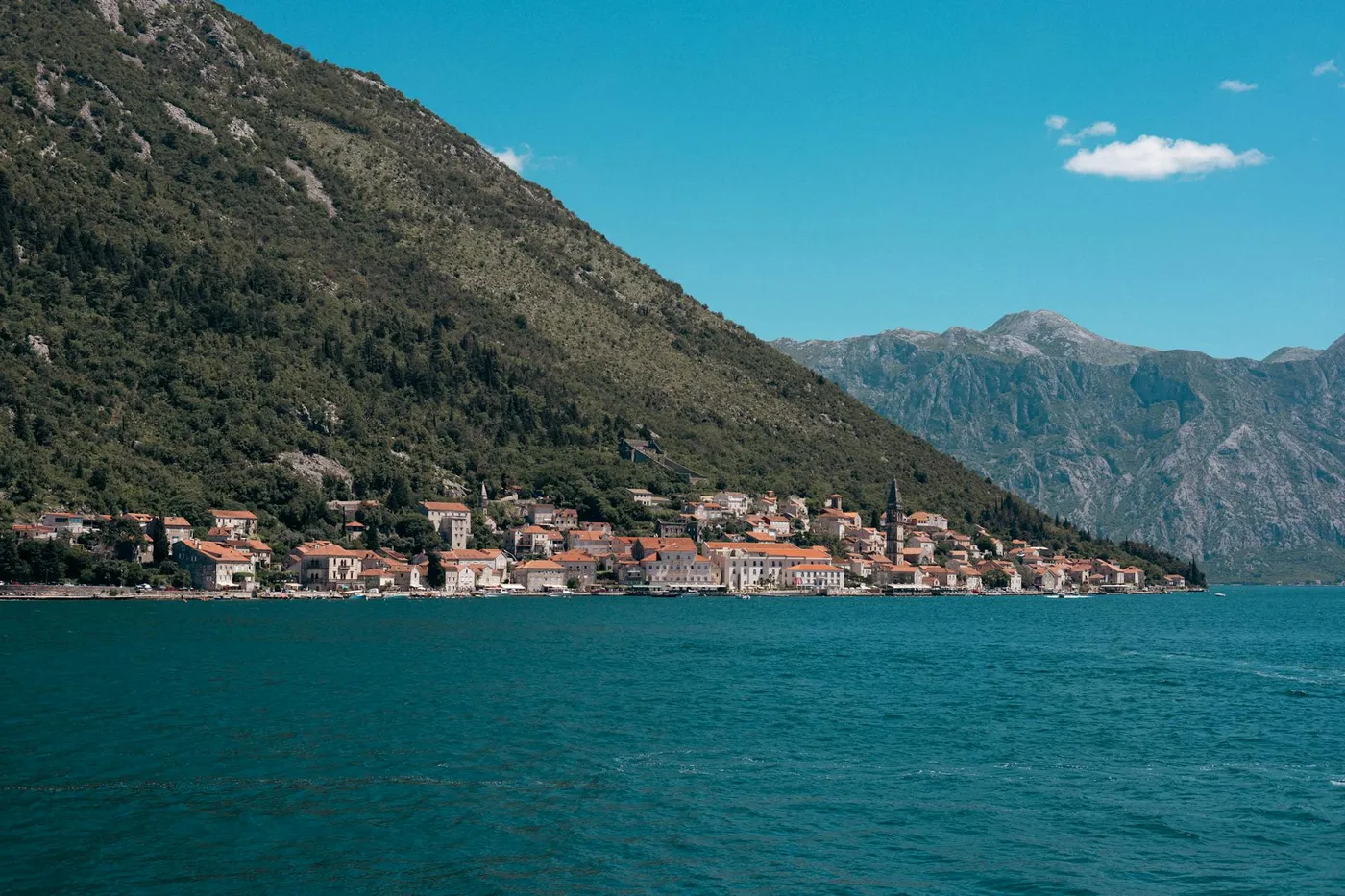
Three stops are worth the slight detour. First, a lay-by on the road above Krašići looking back across Tivat Bay to the airport runway, you can watch your next arrival land. Second, a pull-off on the ridge between Radovići and Traste where both bays open at once. Third, the Žanjic road if you continue further onto the Luštica peninsula proper: this joins up with our Luštica Bay beach drive, which is the natural next step if you have more time.
Olive groves and small agriculture
The peninsula is thick with olive trees, some of which are recorded locally as hundreds of years old. In the terraced plots between villages you'll see the working stuff of Montenegrin coastal smallholding: vines strung between fig trees, a few sheep under netting, lemon and pomegranate in sheltered corners. A handful of small producers sell olive oil at the gate in autumn, look for handwritten maslinovo ulje signs. We can't vouch for specific producers; quality varies, but the local oil tends to be grassy and very green when fresh.
Food on the loop
The Krtoli konobas are the draw. Grilled fish, octopus salad, black risotto, home wine by the carafe. Prices are moderate by Montenegrin coastal standards, less than Porto Montenegro, more than inland. Specific restaurants come and go, so rather than naming names that may have changed hands, ask at your accommodation the morning of the loop. Lunch service runs late into the afternoon in summer.
Practical tips
- Fuel: Top up at the station on the Jadranska magistrala before you head onto the peninsula. Forecourts inside the Krtoli villages are rare.
- Swimming: Pack towels and a swim kit for the car. Distances are short but a lot of the best coves have no changing facilities.
- Road etiquette: Narrow single-track sections use pull-ins. Reverse to the nearest one rather than trying to push past.
- Phones: Coverage is good. Google Maps is reliable here; offline maps are still worth having for the odd dead spot in the hills.
- Best months: May, June, September and early October. July and August add traffic, not catastrophic, but the loop is more relaxing in shoulder season.
For a longer day, combine Krtoli with the Luštica road further out. For the opposite direction, the deep bay road past Perast, see our Tivat to Perast guide.
Which car for the loop
The Krtoli lanes decide the car more than the distances do. The loop itself is short and surfaced, but the spurs down to the coves narrow to a single track with stone walls close on both sides, and the last hundred metres to a swim spot is often gravel. A small hatchback handles all of it with margin; if you plan to chase the rougher tracks to the outer beaches, the SUV class carries the clearance for it. Nothing here needs power, and the smaller the car the easier the three-point turns when a lane ends at somebody's gate.
Most of the roughly 380-car pool is automatic, 314 cars against 66 manuals, which matters on the loop only because hill starts on narrow lanes are less of an event. Unlimited mileage applies on 376 of them, so wandering the peninsula twice costs nothing. The gravel spurs are also exactly where wheel and glass damage happens, and that cover sits only on the two Full tiers, which is worth a thought at checkout rather than afterwards.
Fitting it into arrival day
The loop's great virtue is that it absorbs exactly the awkward hours between landing and check-in. Collect the car, drive the ten minutes south, take the villages slowly, eat a long lunch on the water, and arrive at your accommodation with the holiday already started rather than spent in a cafe with luggage. If the flight lands late, flip it: the loop is even better in the last two hours of light, when the bay goes gold and the lanes are empty.
It works as a last morning too. The loop sits ten minutes from the terminal, which makes it the rare outing you can take with a departure-day deadline: one more slow coffee on the water, one more lap of the olive lanes, and the airport is still a quarter of an hour away with margin to spare.